How to Order a Wedding Cake for 50, 100, or 150 Guests
For 50 or 100 guests, use this wedding cake serving guide to choose enough cake. For 150, consider a larger tier stack or a display cake with kitchen cake. Set a serving target, match it to tier sizes, then count any saved or extra cake separately.
A wedding slice is a portion about 1 × 2 inches, cut through a cake tier’s full height. Your party date, service plan, and guest count all help shape the order. Check whether the cake will be served to everyone or paired with another dessert.
A kitchen cake supplies extra slices behind the scenes, while the tiered cake stays on display. A saved top tier also changes how much cake guests receive. For ideas on planning the meal and dessert service, see wedding buffet reception ideas. Your baker can confirm the final serving count once you know the guest total and service plan.
Wedding Cake Serving Guide: Set a Portion Target
The first choice is whether your guests will receive wedding-size portions or larger party portions. Ask which serving standard your baker uses before you compare cake sizes.
A party cake serving chart may use a larger cut than a wedding chart. The portion standard can change the total servings shown for the same cake.
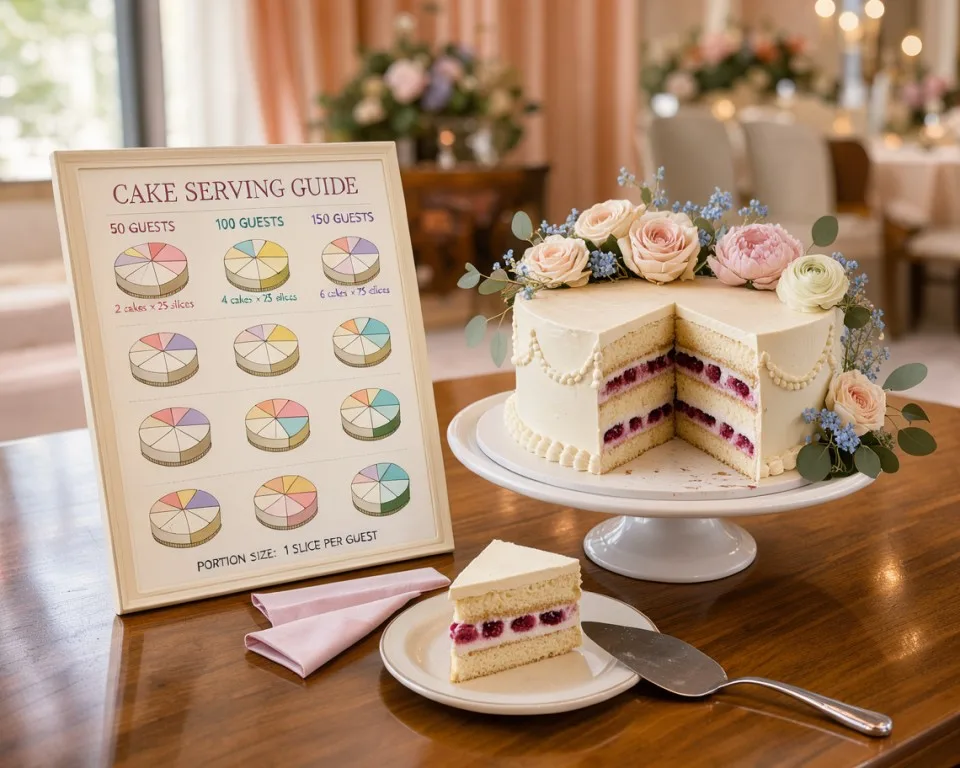
Choose a wedding or party portion
A wedding slice measures about 1 × 2 inches. A party portion measures about 1.5 × 2 inches. Both counts are estimates, and cutting can change the number of slices.
Ask your baker whether the chart counts wedding slices or party portions. A smaller wedding slice can stretch a cake further. A larger party cut gives each person more cake.
Cake height also matters when you read a serving chart. Cakes 3 to 6 inches high in the same-size pan yield the same count with the same cutting pattern. Cakes under 3 inches high yield half the charted servings.
Calculate the number of portions to order
Use the baker’s serving chart, then add the portions listed for each tier. For example, if one tier provides 24 servings and another provides 38, the cake offers 62 servings.
There is no standard U.S. “1/2/3/4 cake rule” for wedding orders. The useful method is to add each tier’s charted servings, then adjust for portions that will not be served.
Ask the baker to state the portion standard behind the quoted serving count. That gives you a clear basis for comparing cakes and cutting plans.
Serving Targets for 50, 100, and 150 Guests
A round 8+10-inch cake yields 62 portions, while a round 8+10+12-inch cake yields 118. Use your confirmed guest count to choose a size with enough servings.
Invitations do not tell you how many people will attend. Finalize the cake order from confirmed RSVPs, not the number of invitations sent.
A practical two-tier choice for 50 guests
The round 8+10-inch two-tier cake gives you 62 servings for 50 guests. That leaves room for a few extra portions without a large display.
Your confirmed guest count may shift as RSVPs arrive. For help setting that number, use this wedding guest list guide. A small cushion can help cover unexpected guests or uneven cuts.
A three-tier choice for 100 guests
A round 8+10+12-inch cake yields 118 servings. That sits within the roughly 110-120 servings often planned for a 100-guest wedding with a safety margin.
A round 6+8+10-inch cake yields 74 servings, which may be too close for some guest lists. A kitchen cake can add servings while the tiered cake remains the display cake.
You can also serve another dessert alongside the cake. Wedding cupcakes offer an easy-to-serve choice with room for different flavors.
Options when you have 150 guests
A round 6+10+14-inch three-tier cake yields 128 servings. It may work when you expect fewer servings to be needed, but it falls short of 150.
A round 6-, 8-, 10-, 12-, and 14-inch five-tier cake yields 208 servings when every tier is served. Saving its 6-inch top tier leaves about 196 wedding-day servings.
A larger five-tier option, with round 8-, 10-, 12-, 14-, and 16-inch tiers, yields 296 portions. Choose based on the confirmed guest count and how much cake you want to serve.
If you plan to save the top tier, count only the tiers that will actually be served on the wedding day.
How Shape and Tier Height Change Servings
A 10-inch square cake serves 50 wedding guests, compared with 38 from a 10-inch round cake. The same diameter can give different totals because shape changes the cake’s area.
Match the pan shape and diameter to the baker’s chart. A chart for three cake layers gives a total when you add each layer’s servings.
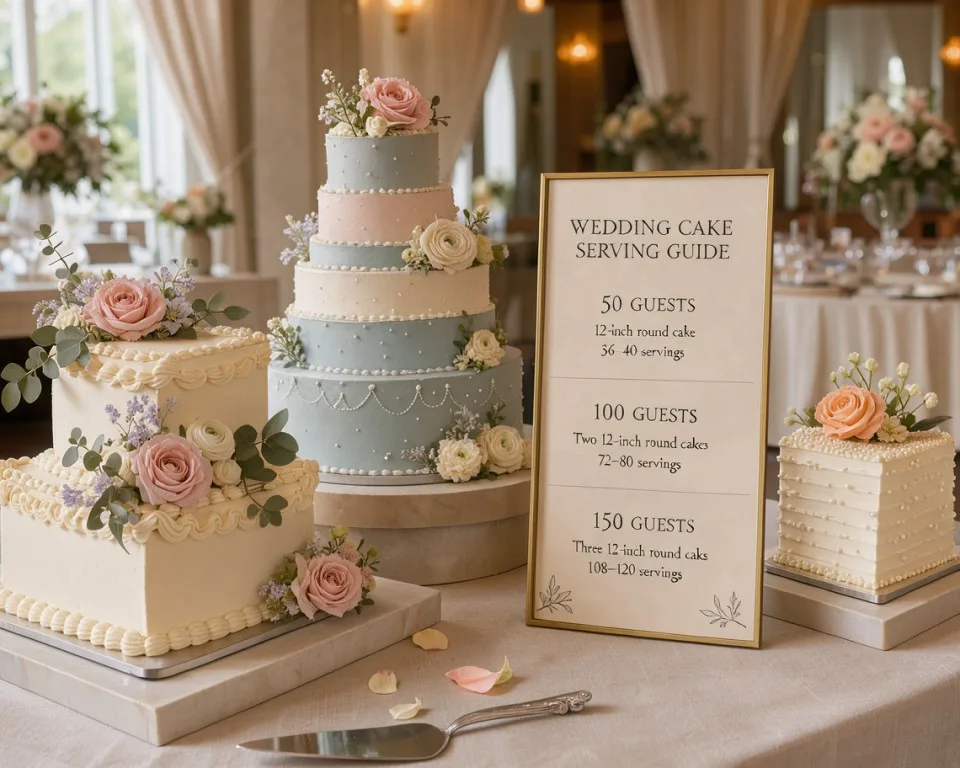
Round and square tiers
A 4-inch-high round cake serves about 12 guests at 6 inches wide, and 24 at 8 inches. The same chart gives 38 servings for a 10-inch round tier.
A 12-inch round tier serves about 56 guests. A 12-inch square tier serves about 72. The square shape provides more servings at that diameter.
At 14 inches, a round tier serves about 78 guests, while a square tier serves 98. At 16 inches, the estimates are 100 and 128, in that order.
A 6-inch square tier serves about 18 guests, compared with 12 from a 6-inch round tier. These counts are estimates, so the cutting pattern matters too.
Tier height and the saved top tier
Cake height changes the charted serving count only outside the usual range. Cakes 3 to 6 inches high yield the same count when cut using the same pattern.
A cake shorter than 3 inches yields half the charted servings. Ask whether the chart assumes a standard tier height before using its total.
To find servings for three layers, add the charted count for each layer. Use the right shape and diameter for every layer, then remove any saved tier from the total.
Some couples choose a custom look with a distinct shape or finish. Japanese wedding cake designs can help you discuss a clear design with your baker.
Confirm the pan shape and finished tier height with your baker before relying on a chart total.
2026 Wedding Cake Costs and Add-On Fees
The 2026 U.S. average is approximately $540, while a typical wedding cake falls in the $300-$700 range. Custom cake prices often run $3-$8 per slice.
The final quote depends on the cake’s size, design, finish, and service needs. Compare the price for the same serving count before choosing a tier count.
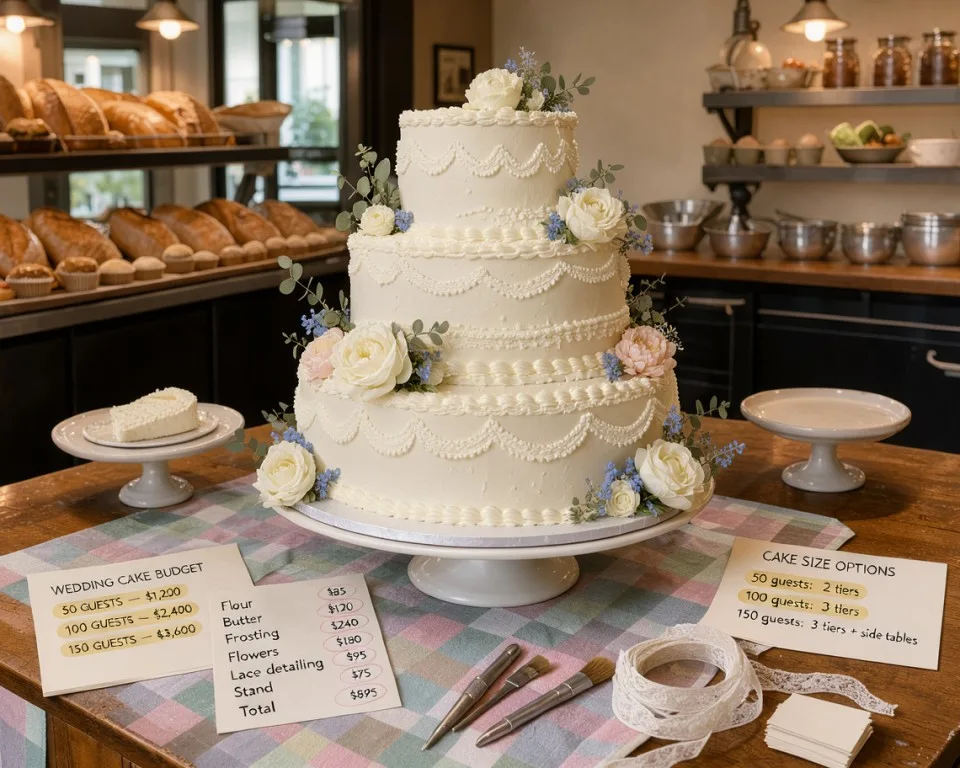
Typical cake prices
A custom-bakery two-tier cake for about 40-60 guests costs $200-$600 in 2026. A three-tier cake for about 75-120 guests costs $400-$800.
A four-tier cake for about 125-175 guests costs $700-$1,500 or more. A three-tier designer or fondant cake for 75-100 guests costs $800-$2,000 or more.
Design and finish can change the price, even when the tier count stays the same. A detailed design may cost more than a simple finish. See wedding flower planning tips for another way to weigh design choices against your budget.
Fees beyond the cake
Delivery and on-site setup are estimated at $50-$200 in 2026. A venue cutting fee commonly adds $2-$5 per slice.
Ask whether delivery, setup, and cake cutting appear in the quote. A venue may charge for cutting even when the cake price includes the baker’s work.
If you want more dessert choices, wedding cake alternatives include options such as pie, cupcakes, and dessert tables.
Compare quotes using the same serving count and ask whether delivery, setup, and cutting are included.
Storage, Timing, and Safe Serving
Storage time depends first on the frosting and filling, so check those ingredients before deciding where the cake should go. Keep the refrigerator at or below 40°F.
Perishable cake should not sit out more than 2 hours, or 1 hour above 90°F. That limit still applies when cake needs time to warm before serving.
Storage by frosting and filling
The “four day cake rule” is not a rule for every cake. Cakes with cream cheese, whipped cream, or custard frosting or filling should stay refrigerated and are best within 3-4 days.
A covered buttercream- or ganache-frosted cake can stay at room temperature for 2-3 days, away from direct sun. Cakes with fresh fruit should be refrigerated and are best within 1-2 days.
Make-ahead and service timing
You can freeze wrapped, unfrosted cake layers for up to 3 months. The safe make-ahead time for a finished cake depends on its filling and frosting.
Let refrigerated cake stand at room temperature for 30-60 minutes before serving. This warming time counts toward the limit for perishable food.
Let cake layers cool fully before splitting them. Chilling the layers can make them easier to handle and less likely to crumble.
Set the cake out close to service time, then move leftovers back into safe storage. You can plan the dessert station with these buffet service ideas in mind.
Keep perishable cake within the stated room-temperature limits, especially at an outdoor reception above 90°F.
Conclusion
A confident cake order is one that matches the portions you intend to serve, not just the display you want. Base the order on your confirmed guest count and the number of servings that guests will receive.
Ask your baker to confirm the final serving count, cut size, and any saved or supplemental cake in writing. A written plan helps your baker, venue, and service team work from the same number.
Send your confirmed guest count and service plan to your baker and request a written serving total.