How to Write Bridal Shower Thank You Cards: A Simple 3-Part Formula
Quick Answer: Write thank you cards in three parts: name the gift and lead with an adjective (what it meant to you), explain why it matters (how it shows your guest knows you), and add one personal detail (how you’ll use it). Send cards within two weeks of the shower. This formula takes five minutes per card and sounds genuine, not generic.
Why Bridal Shower Thank You Cards Matter
Writing 30 thank-you cards sounds like a job, not a joy. But here’s the truth: your guests showed up, chose a gift, and gave their time. A thank you card—even a short one—tells them their effort landed. It matters more than you think.
People remember how you made them feel. A thoughtful note doesn’t have to be long or poetic. It just has to be genuine and show that you actually know who they are. That’s what separates a card that gets recycled from one that gets kept on a shelf.
The best part? You don’t need to agonize over every word. Once you understand the simple formula in the next section, the words come naturally. You’ll spend less time staring at a blank card and more time feeling confident about what you’re writing.
The 3-Part Formula for Writing Thank You Cards
This is the secret: every great thank-you card has three layers. Master this formula and you’ll never have a blank card moment again.
Part 1: Name the Gift and Lead with an Adjective
Start by naming exactly what your guest gave you. Then add one word that captures what the gift meant or how it made you feel. That adjective is what turns a generic “thank you for the gift” into something that sounds like you.
For example, don’t write: “Thank you for the blender.” Write: “Thank you for the gorgeous blender.” Or “the practical blender” or “the amazing blender.” That one word shifts everything.
- Gorgeous = thoughtful about aesthetics, knows your style
- Practical = knows you need real help, not just pretty things
- Generous = acknowledges the gift’s thoughtfulness or cost
- Perfect = shows it was exactly what you wanted
- Thoughtful = signals the care behind the choice, not just the item
Part 2: Explain Why It Means Something
This is where you connect the gift to your life or your relationship. Why does this particular gift matter? Is it something you’ve needed for years? Does it reflect how well your guest knows you? Does it fill a specific gap or solve a real problem?
This part answers: Why are you really grateful? Not just “I like gifts”—but “I like this gift because…”
Examples:
- “It shows how well you know my style, even when I’m terrible at picking things for myself.”
- “We’ve been meaning to upgrade the kitchen, and this was exactly what we needed.”
- “You always know what makes life easier for me—and this definitely will.”
- “This means so much because you took time to find something we actually need and love.”
Part 3: Add One Personal Detail About How You’ll Use It
Here’s the magic: tell your guest one specific thing about how you’ll use the gift. Not someday—now. In the next week or month. This is what makes a card feel personal instead of template-y.
This detail doesn’t have to be profound. It just has to show you’re already thinking about putting the gift to use. It transforms the card from “thanks for the stuff” to “thanks, and here’s how you’ve already made our lives better.”
Examples:
- “We’re planning to use it this weekend when my parents visit—they’re going to love it.”
- “We’ve already tested it out in the new kitchen, and it works perfectly with our setup.”
- “I’m so excited to use this for our morning coffee routine together.”
- “We’re already thinking about the first meal we’ll cook with these new pans.”
That’s it. Three parts. Five minutes. One authentic card.
Ready-to-Use Message Templates by Gift Type
Now that you know the formula, here’s how it looks for every common gift type. Use these as your blueprint, then swap in your own adjectives, reasons, and personal details.
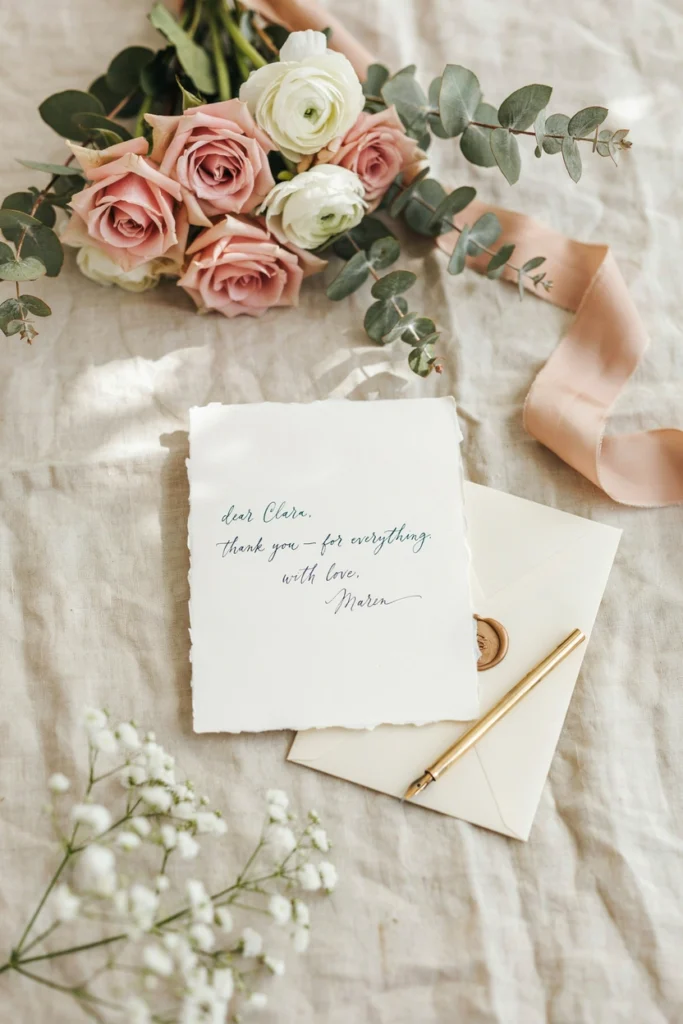
For Money or Gift Cards
Money gifts can feel impersonal if you’re not careful. But when you name the specific amount and explain what it enables, suddenly it feels like genuine partnership in your new life together.
Template:
Dear [Guest name],
Thank you so much for the generous $50 gift card. It meant the world that you thought of us during the shower. Your generosity makes it possible for us to pick out something special for our new home together, and we can’t wait to use it.
We appreciate you so much.
[Your name]
What makes it work: “Generous” (adjective) + the specific amount + “thought of us” (why it matters) + “pick out something special” (personal detail).
Pro tip: Naming the amount isn’t required, but it shows you noticed and appreciated the gift’s value. If you’re uncomfortable mentioning the amount, skip it and use this instead: “Thank you for the thoughtful gift card. Your generosity shows how much you care, and we’re already planning how to use it to create special memories in our new home together.”
For Household Items or Registry Gifts
Most shower gifts fall here—kitchen appliances, bedding, home décor. These gifts are practical, which means your guest paid attention to your needs. Call that out.
Template:
Dear [Guest name],
Thank you for the stunning [item—like “bedding set” or “serving platter”]. It was so thoughtful of you to pick something we actually need. We love how it fits perfectly with our kitchen style, and we’ve already used it twice. Your generosity means the world to us.
Grateful for you,
[Your name]
What makes it work: “Stunning/thoughtful” (adjective) + “fits our style” (why it matters) + “already used it twice” (personal detail).
Pro tip: If you genuinely don’t love the gift, focus on the giver’s intention, not the item. Try: “Thank you for thinking of us during the shower. Your thoughtfulness in choosing something for our home means so much, and we appreciate you being part of this celebration.”
For Experience Gifts (Spa Day, Dinner, Travel)
Experience gifts are gold because they’re about memories. Your guest gave you a reason to celebrate together. Honor that.
Template:
Dear [Guest name],
Thank you so much for the generous spa day gift. It was incredibly thoughtful of you to think about us needing some relaxation time before the wedding. We’re already planning our appointment, and we can’t wait to enjoy this special treat together.
With appreciation,
[Your name]
What makes it work: “Generous/thoughtful” (adjective) + “needing relaxation time” (why it matters) + “planning our appointment” (personal detail about using it soon).
Pro tip: Send this card before you use the gift if possible. It shows extra thoughtfulness when you mention your plan to enjoy it. If you’re writing after the fact, mention the specific memory: “We had the most wonderful spa day last weekend, and we felt so cherished knowing you made it happen.”
For the Shower Host or Hostess
The person who threw the shower deserves extra gratitude. They coordinated, decorated, cooked, and hosted. Make that clear.
Template:
Dear [Guest name],
Thank you so much for hosting the most beautiful shower. It was generous of you to take on all those details and create such a special celebration for us. Every detail—from the flowers to the food—showed how much you care. We felt so loved walking out of that party.
Forever grateful,
[Your name]
What makes it work: “Beautiful/generous” (adjective) + “details showed how much you care” (why it matters) + “felt so loved” (personal detail about the emotional impact).
Pro tip: If the host or hostess is musically inclined or the shower had a music component, you might mention a Bluetooth speaker (if they used one to play music during the shower). But keep it genuine—only if it’s true to the situation.
Wording for Tricky Situations
Not every thank-you scenario is straightforward. Here’s how to handle the tougher cases with grace and honesty.
If You’re Late Sending the Card
Life happens. Work gets busy, the wedding planning spiral consumes you, time disappears. If it’s been more than two weeks, acknowledge the delay without making excuses or over-apologizing.
Opening that works: “I know this is coming late, but I wanted to make sure you knew how much your shower gift meant to us.”
Then move right into the three-part formula. The fact that you’re sending it at all—even late—means something.
Example:
Dear [Guest name],
I know this is coming late, and I apologize. I wanted to make sure you knew how much your thoughtful gift meant to us. It was so generous, and it shows how well you know what we actually need. We’ve been using it constantly and thinking of you.
Thank you for being part of our celebration.
[Your name]
If You Didn’t Love the Gift
Be honest—without being honest. Focus on the giver’s thoughtfulness, not the item. Your guest chose it with good intentions, and that’s what matters.
Example:
Dear [Guest name],
Thank you so much for thinking of us during the shower. It was so thoughtful of you to choose something for our new home. Your generosity and care mean everything to us, and we’re grateful for your support as we start this new chapter.
With appreciation,
[Your name]
Notice: no fake enthusiasm about the actual item. Just genuine gratitude for the intention. This is honest and kind.
If Multiple People Chipped In on One Gift
Send one card to the person who organized the gift. In the card, name everyone who contributed. This way, everyone knows they were part of something together.
Example:
Dear [Primary gift organizer],
Thank you to you, [name], [name], and [name] for the beautiful serving set. It was so generous of all of you to come together and pick something so perfect for our home. We feel so grateful to have friends who put this kind of thought and effort into celebrating us.
With deep appreciation,
[Your name]
Timing, Format & Delivery Questions
You’ve written the words. Now comes the logistics: when to send, how to send, and who should sign. Here’s the straight answer to every question.
When Should You Send Thank You Cards?
The traditional etiquette rule—and it’s a good one—is within two weeks of the shower. Real talk: this is the window where gratitude feels fresh and connected to the actual event.
The absolute deadline is one month. After one month, a late card starts to feel like an afterthought instead of genuine appreciation. Two weeks is the sweet spot.
Timeline that actually works:
- Day after shower: Snap a quick photo of the gift list or jot notes about who gave what. You need this reference.
- Within 3–5 days: Sit down and write all your cards in one session. Momentum is your friend.
- Within two weeks: Mail them. Done.
Should You Handwrite or Type?
This is the question that stops people cold. Here’s the real answer: handwritten feels more personal. Typed feels more modern. Both are acceptable. The difference in impact is smaller than you think.
| Handwritten | Typed |
|---|---|
| Feels: Personal, warm, thoughtful | Feels: Clean, organized, professional |
| Time: 10–15 minutes per card (slower) | Time: 5 minutes per card (faster) |
| Best for: Close friends, family, hosts | Best for: Large guest lists, modern aesthetic |
| Impact: Guests often keep and treasure these | Impact: Professional and appreciated, recycled more often |
Our take: If you have the time and handwriting you don’t hate, handwrite. If you’re staring at 40 cards and want to stay sane, type. Either way, the genuine words matter more than the medium.
Pro tip: Do a hybrid. Handwrite the ones for people you’re close to. Type the rest. Everyone gets a genuine message either way.
Can You Send Digital or Email Thank Yous?
Short answer: only if the gift was very informal or digital (like a Venmo gift). For actual shower gifts, a physical card is the expected standard.
Digital thank yous work for:
- People who specifically said “please don’t get me a gift” but gave money anyway
- Very close friends or family where you text anyway
- Gifts given via digital platforms
Digital thank yous don’t work for:
- Physical gifts from people you don’t text with regularly
- Formal showers or traditional contexts
- Monetary gifts from older generations
When in doubt, send a card. People don’t complain about getting too many thank you cards. They do notice when they don’t get any.
Who Should Sign the Card?
This depends on your situation:
- If you’re the bride and your fiancé isn’t expected to know all the shower guests: Sign your name only. “With gratitude, [Your name]”
- If it’s a joint celebration and your fiancé knows the guest: Both sign. “With gratitude, [Your name] and [Fiancé name]”
- If the gift is specifically for both of you: Both sign. The gift givers gave with both of you in mind.
Pro tip: Have your fiancé sign even if it’s “his side” of the family. It takes 30 seconds and doubles the personal touch. Two signatures = two people are grateful. That matters.
Final Checklist Before You Mail
You’ve written your cards. Before they go into the mail, run through this quick checklist. These five minutes can catch mistakes that undermine all your good work.
| Check | Why It Matters |
|---|---|
| Did you spell the gift giver’s name correctly? | Nothing says “I don’t know you” like misspelling a name. Double-check. |
| Did you name the actual gift? | A specific gift name (not just “gift”) shows you paid attention and are genuinely grateful. |
| Did you include one personal detail? | This is the detail that makes the card memorable instead of template-y. |
| Does the tone match your relationship? | A card to your aunt shouldn’t sound the same as a card to your college roommate. Read it aloud and make sure it sounds like YOU. |
| Did you avoid “amazing,” “awesome,” “so grateful,” for the hundredth time? | Adjective variation matters. Switch it up: “generous,” “thoughtful,” “perfect,” “brilliant,” “kind,” “beautiful,” “clever.” |
| Is the handwriting legible? | If people can’t read it, your words lose power. If your handwriting is messy, type instead. No judgment. |
| Did both people sign (if applicable)? | It only takes 10 seconds and makes the gift feel acknowledged by both of you. |
Frequently Asked Questions
How soon after a bridal shower should thank you cards be sent?
Within two weeks is the standard, and it’s the sweet spot. After one month, you’re getting into “late” territory. Send them ASAP after the shower while gratitude is fresh and connected to the event.
What do you write in a bridal shower thank you card?
Use the three-part formula: name the gift and lead with an adjective (what it meant), explain why it matters (how it shows they know you), and add one personal detail (how you’ll use it). This takes five minutes and sounds genuine, not robotic.
Can you send a thank you email instead of a card?
Only for very informal situations or digital gifts. For physical shower gifts, a handwritten or printed card is the expected standard. A card shows more effort and thoughtfulness than an email, even if the words are the same.
Do thank you cards need to be handwritten?
No. Typed cards are completely acceptable and often preferred if your handwriting is difficult to read. What matters is genuine words sent promptly, not the medium they arrive in. Do what works for you.
What if I misspelled a guest’s name on the card?
It happens. If it’s a close friend or family member, a quick text or call is fine: “I just realized I misspelled your name—my apologies!” Most people understand. If you’re mortified, you can always send a replacement card. But honestly, most people won’t notice or care.
Should the groom sign the thank you card too?
Yes, if he knows the gift giver or the gift is meant for both of you. Both signatures double the personal touch and show that both people are grateful. It takes 30 seconds and means more than you’d think.
How long should a thank you card message be?
Three to five sentences is perfect. Long enough to feel genuine and specific, short enough to actually send promptly. People appreciate brevity—it shows you’re busy living life, not writing a novel about every gift.
What if I’m sending a thank you card several months late?
Acknowledge the delay briefly without over-apologizing: “I know this is coming late, and I wanted to make sure you knew how much your gift meant to us.” Then move into the genuine gratitude. Late is still better than never.
Is it appropriate to mention the amount of a money gift?
It’s optional. Some people prefer to acknowledge the specific amount (it shows you noticed and appreciated the generosity). Others skip it to avoid any awkwardness. Both are fine. Go with what feels comfortable.
What’s the difference between thanking the gift giver and thanking the shower host?
Gift givers get cards thanking them for the specific gift. The shower host gets a card thanking them for the event—the time, energy, planning, and care they put into creating the celebration. Both are important, and both deserve their own card.
Key Takeaways
Writing bridal shower thank you cards doesn’t have to be hard. Use this three-part formula for every card: name the gift with an adjective, explain why it matters, and add one personal detail about how you’ll use it. Send cards within two weeks. Whether you handwrite or type, the genuine words matter more than the medium. Your guests gave their time and thoughtfulness. A thank you card—even a short one—tells them their effort landed. That’s what makes it worth doing.