How to Estimate How Many Wedding Guests Will Actually Attend
For a local wedding, expect a 75%-85% wedding guest attendance rate. Destination weddings usually draw a smaller share.
In-seat attendance means the number of invited guests who are physically present on the wedding day. That count helps you make wedding planning choices with less guesswork.
An RSVP yes is a confirmed response, not proof that someone will attend. A guest may have to cancel, even after saying yes.
Your headcount affects the room, the meal, and your budget. A careful estimate can help you plan without expecting every invitee to show up.
Use the number of people invited as a starting point, then consider travel and other known limits. You do not need to guess perfectly to make sound choices.
This approach gives you a practical range to use as replies come in. Treat any early estimate as a planning range, not a promise about who will be there.
What Is the Wedding Guest Attendance Rate for Your Wedding?
A local wedding typically draws more invitees than a destination wedding, and travel distance changes each guest’s estimate. A mixed list needs more than one rate.
Use the group that best fits each invitee. The whole-list estimate for a local wedding and the rate for destination-only guests describe different groups.
Local weddings
About 75%-85% of invited guests attend local U.S. weddings. That range works as a first estimate when most guests live close enough to travel without a major trip.
Local guests may find it easier to attend than people who need flights, hotels, and time away from work. Still, a local list can include people who live far away.
The Knot’s RSVP yes sweet spot is about 80%. Use it as a planning reference for yes replies, not a promise that 80% of invitees will sit in the room.
These figures describe different points in your planning. One estimates attendance from the full invitation list; the other is a useful guide for the share expected to reply yes.
Destination and travel-heavy guest lists
Destination wedding attendance is estimated at 60%-70% overall. That figure includes guests with different travel needs, so it does not mean every group has the same chance of attending.
Destination-only guests have an estimated in-seat attendance rate of 30%-45%. For a mixed list, local guests attend at about 85%, out-of-town guests at about 55%, and destination-only guests at about 35%.
Those group rates help explain why the overall destination estimate can be higher than the rate for destination-only guests. The whole-list figure can include local guests and other people with shorter trips.
Do not treat a mixed list as one uniform audience. Estimate local guests, out-of-town guests, and destination-only guests separately, then combine the results.
For a list with many travelers, use the lower end of the relevant range rather than assuming the local-wedding rate.
Turn RSVPs Into a Realistic Final Count
An RSVP yes is a useful commitment, but it is not a guarantee that the guest will be in a seat on the day. A confirmed response can still change before the wedding.
A decline and a late cancellation are not the same. A decline means the guest says no; a late cancellation happens after a guest has already replied yes.
The Knot’s rule of thumb is that 20% of invited guests decline. Use that as an early estimate before real replies give you a clearer count.
For example, if you invite 100 people, the rule suggests that about 20 may decline. It does not tell you which guests will say no.
Update your estimate as replies arrive. Replace the early assumption with actual responses, and keep track of how many people each reply covers.
Do not treat a missing reply as a no. A guest who has not responded may still attend, so an unanswered invitation is not the same as a decline.
Late changes can shift the count again. About 5%-10% of guests who RSVP yes cancel late, so leave room for that possibility in your working estimate.
That late-cancellation share is a planning guide, not a list of people who will cancel. A guest’s plans can change for many reasons after the reply arrives.
Keep the RSVP yes total separate from the final attendance estimate until late changes are accounted for.
Estimate Your Headcount Guest by Guest
Start with the actual names on your list, because one percentage can hide big differences in travel distance. A household can include people with different plans.
Write down each invited person, not only the number of invitations. Then sort names into travel groups and estimate those groups on their own.
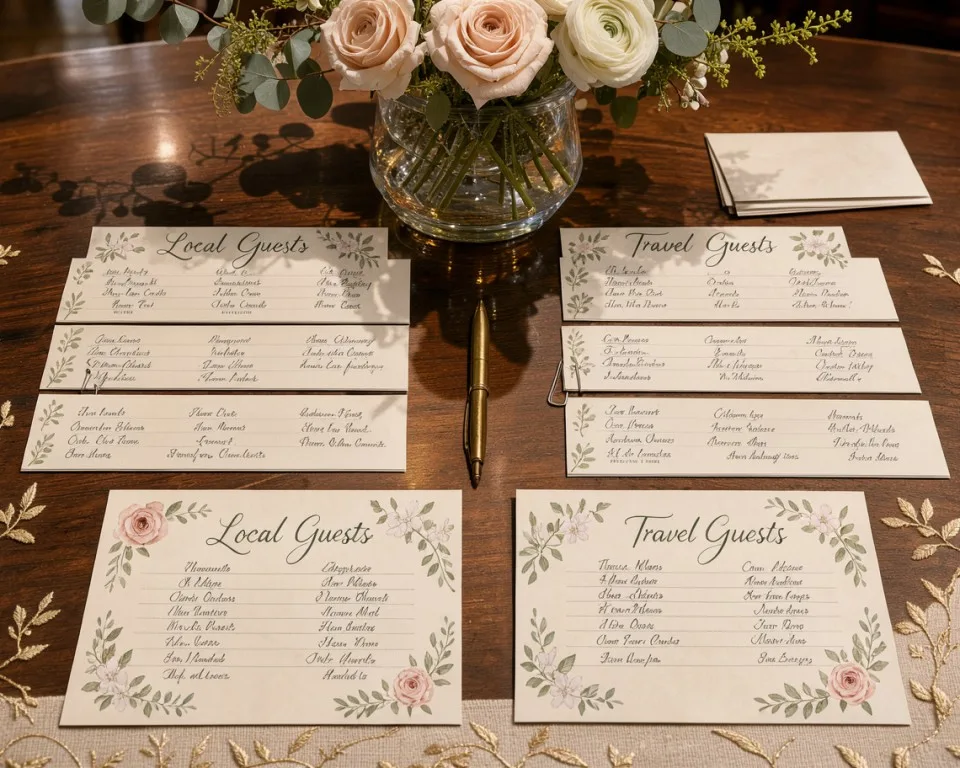
Sort the list into travel groups
Use this short process to build a headcount before every reply arrives. It works best when each person appears once.
- List every invited person by household.
- Group each person as local, out-of-town, or destination-only.
- Estimate each group with the matching rate from the earlier section.
- Add the group estimates, then update them as replies arrive.
A household should not count as a single yes or no if its members answer differently. One person may attend while another cannot make the trip.
Keep the group names plain and clear. A person who lives nearby belongs in the local group, while a person who needs a trip belongs in the fitting travel group.
Check the estimate against a real example
For 200 invitations to a local wedding, estimated in-seat attendance is 150-170 guests. That range gives you a useful first count, not an exact headcount.
U.S. weddings held in 2025 averaged 117 guests. That average offers context for wedding planning, but it is not a target for your own list.
Your number may be higher or lower because each guest list has a different size and mix. A small guest list can have a high attendance rate and still fall below the average.
Do not change your estimate just to match a national average. Use your own names and travel groups as the basis for your number.
Recalculate the total when a group’s travel plans or confirmed responses change.
Account for the Factors That Change Attendance
A guest’s travel burden and relationship to you can matter more than the total size of your list. A person may care deeply and still be unable to come.
Check the real limits that affect each guest or family. These details help you adjust a first estimate without guessing how much someone cares.

Travel, cost and closeness
Flight and hotel costs can make a wedding trip hard to afford. Distance can also mean more time away from work, especially for guests with a long journey.
Closeness to the couple matters, too. In 2023, guests were 10% more likely than in 2022 to consider how close they felt to the couple.
A distant guest may decline even when the two of you are close. Do not read a no as proof that the relationship matters less.
Timing, family needs and access
Review each guest’s dates and needs. A busy time of year can compete with plans already on the calendar.
- Flight and hotel costs for the trip
- Travel distance and time off work
- How close the guest feels to you
- Holiday or busy-season conflicts
- Childcare and whether children are invited
- Accessibility needs at the venue
Christmas, New Year’s Eve, and the Fourth of July can bring competing plans. A date in a busy season may affect guests who would gladly attend another weekend.
Childcare also changes what is possible for some families. Clear child policies help guests know whether they need care before they reply.
Accessibility can affect whether a guest can take part with ease. Think about the route, the space, and the guest’s needs when estimating attendance.
Make a personal adjustment for known constraints instead of applying the same rate to every invitee.
Set an RSVP Timeline That Gives You Time to Plan
Give guests enough notice to plan, then leave yourself a firm window to collect and confirm replies. Your final count needs to reach vendors on time.
Set each date by counting back from the wedding day. This leaves guests time to answer and gives you time to follow up.
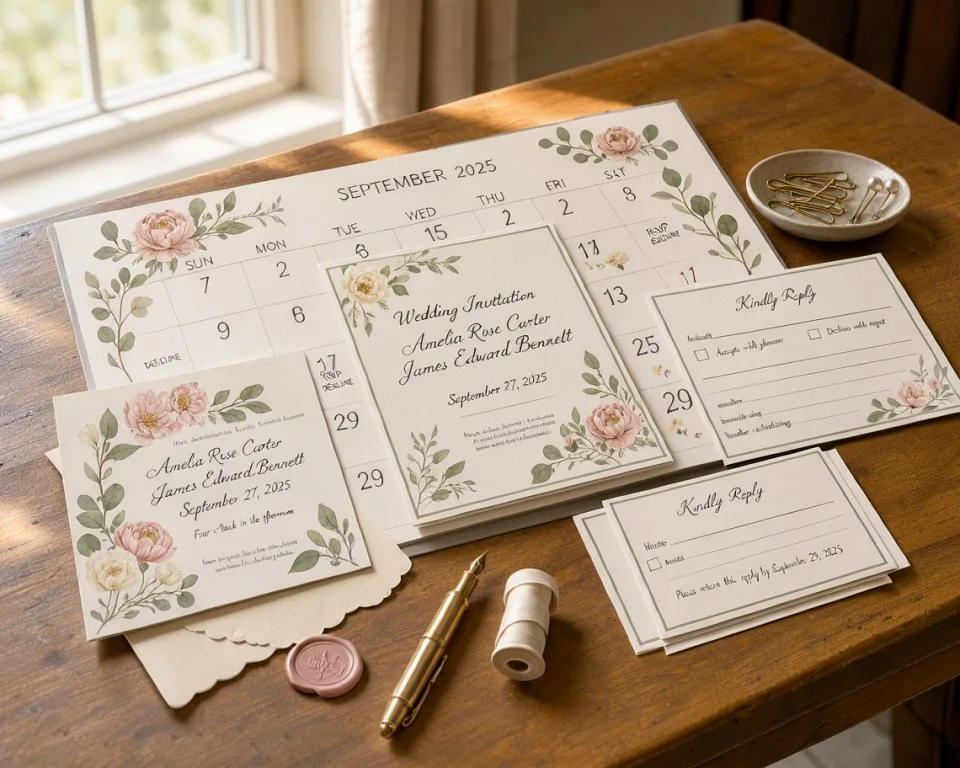
Give guests advance notice
Save-the-dates help guests plan around travel and work. Send them 7-10 months before the wedding, especially when guests need to arrange a trip.
Formal invitations come later. Mail local-wedding invitations 6-10 weeks before the wedding, and send destination-wedding invitations 10-12 weeks ahead.
For other date-based tasks, a month-by-month wedding planning timeline can help you set a workable order. Keep the reply dates tied to the vendor deadlines you have.
Set a deadline and follow up
Use this timeline checklist to set dates that leave time for a final count. Adjust the vendor handoff only when their stated deadline allows it.
- Send save-the-dates 7-10 months before the wedding.
- Mail local invitations 6-10 weeks before the wedding.
- Mail destination invitations 10-12 weeks before the wedding.
- Set the RSVP deadline 3-4 weeks before the wedding, never later than 2 weeks.
- Follow up with guests who have not replied after the deadline.
- Send the final count to vendors around two weeks ahead, if their deadline allows.
A fixed reply date gives you a clear point to check for missing answers. Follow up after that date with guests who have not sent a response.
Some vendors need your count before the two-week mark. Their contract or planning notes may set an earlier date, so leave room for that need.
Check your venue and caterer’s final-count deadline before choosing the RSVP date.
Protect Your Budget and Venue Plan With a Realistic Count
Your guest count affects the budget most directly through expenses that rise with each person. Food and drinks are often among your largest wedding costs.
Food, beverages, rentals, invitations, and favors can all add per-person costs. A small change in headcount can change what you pay for these items.

Know which costs rise with each guest
U.S. weddings held in 2025 had an average cost of $34,000 for 10,474 couples. The average was $292 per guest, a national figure rather than a quote for your wedding.
Your actual costs depend on your venue, menu, service, and choices. Use vendor quotes to plan your own event, not the national average alone.
Compare what each catering price includes. Food may not cover staffing, rentals, setup, cleanup, delivery, fees, or taxes.
For a closer look at quote details, use this guide to compare wedding catering costs. Ask vendors to price the same guest count and service details.
Set the budget around venue and food
Venue and food are likely to be your largest expenses. In 2026, venue costs average $8,573, with a typical range of $6,900-$10,300.
In 2026, catering costs average $6,927, with a typical range of $5,500-$8,300. Your final quote can change with the guest count and service choices.
The 50/30/20 wedding-budget rule assigns 50% to venue, food, and drinks. It gives 30% to attire, photos, entertainment, flowers, and décor.
The last 20% covers other expenses. This 50/30/20 budget rule is a starting point, not a rule every couple must follow.
A 100-guest U.S. wedding in 2026 typically has a realistic budget of $25,000-$45,000. Your plans may need a different amount based on your venue and choices.
You cannot reliably estimate a 250-guest budget by multiplying an average per-guest figure. Some costs rise with each person, while other costs do not change in the same way.
Trim the list with a clear trade-off
Removing 20 guests can often save thousands of dollars in per-person expenses. The amount depends on what your food, drinks, and other guest costs include.
Decide what matters most before removing names. You might keep a larger meal or a favorite venue by inviting fewer people.
A guest-list plan can help you set fair rules for close family, friends, coworkers, and plus-ones. Keep the rules steady as you review names.
Confirm the venue’s capacity and the caterer’s pricing basis before you make a final guest-list cut.
Keep RSVP Records Accurate as Replies Arrive
Record replies by each named guest, not just by invitation, so a partial household response does not distort your count. A household can have both yes and no answers.
Use one shared tracker so you and your planner can see the same count. Google Sheets can hold a live guest tracker that you update as replies come in.
Give the tracker one row for each invited person. Include enough fields to tell who is coming and what each person needs.
- Each invited person and household
- Response and number attending
- Plus-one or child status
- Meal choice and travel notes
Do not mark an entire household yes when only some people accept. A household invitation can have a partial yes, so count each person separately.
Offer guests a clear way to reply. A QR code can send them to a wedding website RSVP form.
Paper cards work, too. Include a pre-addressed, stamped return envelope so guests can mail the reply back with less effort.
Silence is not a decline. Keep unanswered guests marked as waiting until you receive a reply or follow up with them.
A shared wedding guest list tracker can hold contact details and meal choices alongside each reply. Compare the tracker’s total against the written RSVP cards or digital responses before you send the vendor count.
Prepare Seating for Late Changes
A confirmed count still needs a little day-of flexibility for arrivals and last-minute changes. A few open chairs can help you respond without a scramble.
Weddings with more than 50 guests generally need a seating chart. Round tables usually fit about 8-12 guests, which gives you a useful starting point.
Check how the venue handles a small change in attendance. Ask the venue and caterer how much the final count can flex.
Use these practical checks when you prepare the room:
- Ask how much the venue and caterer can change the final count.
- Keep a few spare chairs available.
- Merge tables with gaps instead of spreading empty seats.
- Give a planner or trusted person day-of seating duties.
Empty spaces can make a table feel scattered. Merging tables with gaps can keep the room more comfortable for the people who arrive.
A spare chair can help with an unexpected arrival, but it does not change the meal count. Keep the venue’s rules in mind when making a seating change.
A seating chart is especially useful once your guest count is above 50. Round tables often hold about 8-12 people, though the venue’s table size sets the fit.
Give one trusted person responsibility for seating fixes so you can stay present with your guests.
Build a Guest List That Fits Your Priorities
Set your preferred guest-list size before you start negotiating individual names. A clear target helps you make choices that fit your celebration.
A 150-guest wedding is not unusually large, but it tops the common 100-150 range. A 130-person wedding falls within that common range, not below it.
Set the size before adding names
The most common U.S. wedding size is 100-150 guests, representing 31%-34% of weddings. The average guest count at U.S. weddings held in 2025 was 117.
Start with the number that fits your space and the kind of gathering you want. Then write down close family and friends before adding other groups.
Choose how to handle extended family, coworkers, plus-ones, and children. A shared set of rules can help you and your partner make choices without changing standards for each name.
If you are also planning a shower, games for bridal showers with large groups can help you plan that separate event. Keep its guest count distinct from your wedding list.
A list that fits your priorities is easier to review than one built around hopes that many guests will decline. Leave room for the people you most want beside you.
Make plus-one and child rules clear
State plus-one rules clearly on the invitation. Guests should know whether they may bring someone and how many seats their invitation allows.
Make your child policy clear, too. Guests need to know whether children are invited so they can plan care or travel with their family.
These choices shape the number of possible attendees before replies come in. Clear wording helps guests answer for the right number of people.
Agree on plus-one and child policies together before invitations go out.
Conclusion
A dependable estimate comes from matching your guest list to the travel involved and updating it as real replies come in. No early count can promise exactly who will attend.
Use the estimate as a planning tool, not a test of how much your guests care. A late change does not erase the care behind an invitation.
Your next step is simple: enter each invited person in one tracker, then update the count as responses arrive. Start by adding every invited person to your tracker and marking the travel group you expect them to be in.