
How to Plan a Backup for an Outdoor Wedding
An outdoor celebration is easiest to protect when you reserve a real indoor or tented fallback, decide who can activate it, and tell your team how the day changes. An outdoor wedding rain plan gives you a sheltered place and a clear way to use it.
Forecasts can shift, so no early prediction can promise a dry wedding day. A prepared backup helps your ceremony and reception keep moving when rain arrives.
Measurable rain means precipitation of at least 0.01 inch. In a recent survey, 58% of couples hosted an outdoor wedding ceremony.
Your decision owner should know when to switch and who must hear the call. Your vendors and guests also need simple directions before the day.
Choose a setting only if you would still be happy celebrating in its backup space.
Build an Outdoor Wedding Rain Plan Around a Real Backup Venue
A venue is a workable choice only when you can picture the ceremony and reception in its rain-ready setting. A useful Plan B includes two confirmed arrangements, outdoor and sheltered, plus one named decision owner.
Tour both settings before signing the venue contract. Ask whether the backup is an indoor room, covered pavilion, or another approved space.
Confirm that the room fits your guest count and planned layout. Check clear paths, step-free access, and any added room charge.
Ask who can approve the switch and how guests move between the ceremony and reception. A room may need a reset before dinner, so learn who handles that work.
Do not assume a small lounge or lobby can hold the full event. Ask to see chairs, tables, and service areas arranged as you expect to use them.
A backyard or private property needs a separately secured sheltered option. A neighbor’s porch or a small home room may not hold the whole event.
For a rustic site, look at campground wedding ideas that include covered gathering space. Treat a lounge tent as backup only when its size and access suit your guests.
Ask whether your venue allows the backup space to stay ready or needs time to clear it. That answer can shape the ceremony time and the room layout.
Ask to see the backup space set for the number of guests on your contract before you commit.
Outdoor Wedding Weather: Use Local Rain Odds, Not Statewide Assumptions
Climate averages help compare typical months and places, but they cannot tell you whether it will rain at your ceremony. Outdoor wedding weather decisions need local history and a current forecast.
What the Climate Normals Say
NOAA’s Climate Normals cover 1991 through 2020. They give typical climate statistics for thousands of U.S. locations.
At a typical U.S. weather station, measurable rain is possible on 23.7% of September days. October’s figure is 24.2%, while June reaches 31.3% and May 32.9%.
A June day is 29% more likely to bring measurable rain than an October day. These monthly rates describe climate, not the forecast for your wedding day.
Across May, June, September, and October, California’s average chance is 6.9%. Hawaii’s average is 44.8%, the highest state figure in the index.
State averages can hide big changes by month. Florida’s chance is 47.3% in June and 26.1% in October.
Washington shifts the other way, from 13.9% in July to 46.0% in October. One state number cannot describe every date or place.
How to Use the Odds When Choosing a Date
Use a nearby weather station’s Climate Normals to compare seasons or locations. A city, coast, or mountain site may differ from the state average.
Look at the month and place together, rather than relying on a state’s broad rate. A local station can help you compare likely conditions across several possible dates.
Climate Normals help you judge what is typical, while a current forecast guides the event-day call. Check the local forecast as the wedding gets closer and follow your agreed process.
When you compare dates, also think about the time of day. Morning and evening weather can differ, and monthly averages do not predict either one.
Use climate normals to compare dates or locations, then keep the actual event decision tied to the local forecast.
Tent Options, Sizing, and Costs for a Rain Plan
A tent quote is useful only when it matches the site, guest count, and complete layout you need. The best tent structure depends on the property, the ground, and how you will use the space.
Get permission from the venue or property owner before booking. Confirm access for delivery, anchoring needs, and the rental company’s approved setup.
Choose a Structure That Fits the Site
A frame tent uses a metal frame and can stand without center poles. A pole tent uses center poles and needs room for its stakes.
Clear-span tents use strong frames to create open space without interior poles. Clear-top tents let in daylight, but they may need extra care in warm or bright weather.
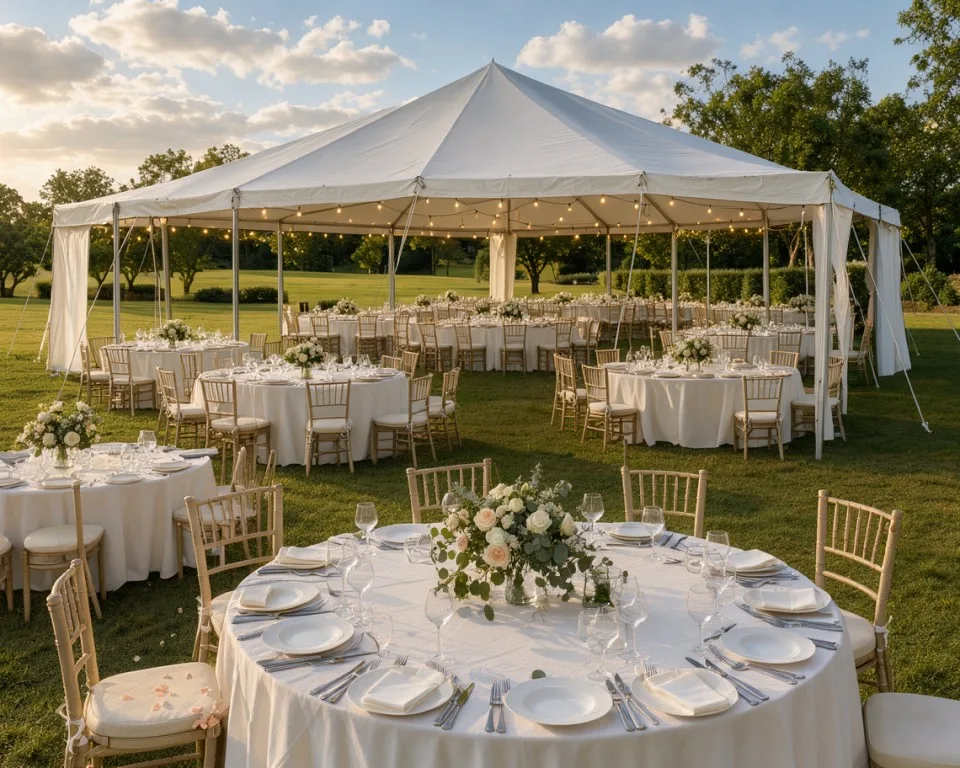
No style suits every event. Ask the rental team which options can safely fit your ground, access, and guest layout.
A seated dinner needs about 12-15 square feet per guest for guest areas. Add space for the bar, dance floor, buffet, and DJ setup.
Use that guest-area number as a starting point, not the full tent size. The service spaces and paths also need room.
Ask where poles, support lines, and tent doors will sit. They can affect table plans, walking paths, and views from the ceremony seats.
Price the Complete Setup, Not Just the Tent
In the United States in 2026, a tent structure rental costs $500-$2,800 before add-ons. For 100-150 guests, a complete tent setup with flooring, lighting, and climate control typically costs $5,000-$12,000.
Full sidewalls typically cost $500-$1,200. Tent flooring typically costs $400-$4,000, and setup and delivery typically cost $400-$1,200.
Flooring can mean dance-floor panels, rugs, or a raised platform. Ask what works on the site and keeps guests steady in wet shoes.
Lighting and climate control can change the bill, too. Ask whether the quote covers installation, delivery, and removal, not just the rental days.
Ask how rain runoff will drain around the tent. A dry floor can still be hard to reach if water pools along the entrance.
Get an itemized quote that separates the structure, sidewalls, flooring, lighting, climate control, setup, and delivery.
Handle Last-Minute Rain at an Outdoor Wedding Safely
If the forecast changes at the last minute, follow the decision process you agreed on with the venue and coordinator. Move to Plan B when the agreed conditions call for it.
Use the 10-day forecast to bring the decision into view. Before the wedding, agree on timing, who makes the call, and which people must be consulted.
Rain is not the only hazard. Lightning, strong wind, extreme heat, or poor ground conditions may also make an outdoor event unsafe.
There is no safe wind-speed number for every event tent. Its safe limit depends on the maker’s rules, engineering, installation, anchoring, and local conditions.
Ask the venue or tent professional to assess the setup. Do not guess based on a phone forecast or a general wind number.
The National Weather Service says to wait at least 30 minutes after the last thunder before resuming outdoor activity. Follow that rule even if the rain has stopped.
A fall wedding can face cold, wind, and early sunsets as well as showers. See fall wedding planning tips when you weigh seasonal conditions.
The decision owner should tell the coordinator when to act, not wait for every guest to agree. A clear call helps avoid a rushed move during a hazard.
For last-minute rain at an outdoor wedding, use the agreed backup instead of improvising outside when conditions are unsafe. Give the venue authority to stop outdoor activity when conditions are unsafe, even if the forecast looked manageable earlier.
Build a Second Timeline and Assign Vendor Handoffs
Your rain version needs its own timings and task assignments, not just a different ceremony address. Prepare two run-of-show versions, one for outdoors and one for Plan B.
Share the alternate timeline with affected vendors at least two weeks before the event. Give the team enough time to spot conflicts and confirm each handoff.
Set the Alternate Run of Show
Write the ceremony, cocktail hour, dinner, and dancing in order for both settings. Add the time needed for a room reset or equipment move.
A room already set for dinner may not be ready for an immediate ceremony move. Name who resets it and how much time that job needs.
Keep each version easy to scan. Put the planned start times beside the activity, then mark any step that changes under Plan B.
Include the time needed to greet guests at the new location. A quick move on paper can take longer when people need clear routes and help.
Make sure the ceremony time still works for the reception meal. If the room reset takes longer, choose which later activity can shift.
Give Each Vendor a Defined Task
Have the florist confirm which arrangements move and who carries them. The caterer should confirm the service layout and any change to meal timing.
Ask the photographer about ceremony timing and access to key moments. The DJ or musicians should confirm power, sound placement, and their setup time.
The rental team should say what it moves and where it belongs. Ask the officiant to confirm the alternate ceremony time and arrival plan.
Your venue coordinator should confirm room access and the people who can open each space. Each vendor should accept the task that affects its own work.
Ask each lead to check the timeline against their own arrival and setup needs. Record any change that affects another vendor’s work.
A wedding planner can keep the handoffs clear, but one person should not carry every task. Check for jobs with no named lead before sharing the final plan.
Put each lead’s name, role, and phone number on one shared contact sheet.
Keep Guest Arrival and Movement Comfortable
Guests need one clear destination and a firm, comfortable way to reach it. Plan two routes in advance: the main path and a weather backup.
Choose a paved or firm route if grass or gravel may turn slick. Use non-slip mats where guests cross wet floors or thresholds.

ADA accessible routes generally need 36 inches of clear width, with limited exceptions. The U.S. Access Board’s route rules also cover walking surfaces and turns.
Consider a sheltered waiting spot, umbrellas, towels, and a place for wet coats or shoes. Keep each route open for wheelchairs and guests who walk slowly.
Check the path after rain if the site has loose gravel, roots, or a steep slope. A short detour may be safer than a direct route that gets muddy.
For a coastal wedding, wind and sand can affect the walk to the ceremony. These beach wedding ideas can help you plan around the setting.
One designated person should send the final location and arrival update through the channels guests already use. Give the update before guests leave for the venue.
Keep someone at the original entrance until late arrivals have received the updated directions.
Protect the Photo Plan Without Expecting Perfect Weather
A rainy forecast changes the photo locations and timing, not the value of the photographs. Prepare one covered setting and one safe outdoor setting with your photographer.
Visit indoor or covered portrait spots before the wedding. Check the light, available space, and how long it takes to reach each place.
If rain is likely, consider taking priority portraits before the ceremony. This leaves less pressure after the vows if showers begin.
Overcast light can make soft portraits possible, but it does not make every outdoor photo practical. Your photographer can judge the setting and gear on the day.
Ask which family groupings matter most to you. A short list can help you use the time well if the weather changes.
Keep couple-only umbrella portraits separate from guest rain supplies. A clear or simple umbrella can frame a portrait without changing guest access.
Build about 15-30 minutes of flexibility into the portrait schedule. Keep a portrait buffer before dinner so a slow transition does not compress the reception.
Adapt Ceremony Decor and Equipment for a Wet Setting
Decor that works outdoors may need a different placement or material when it moves under cover. Prepare two décor placements, one for each ceremony setting.
Ask your florist which pieces can move and which need a separate indoor arrangement. Portable bud vases and simple greenery may suit a smaller room.
Check the dimensions and installation method for an arch or large floral piece. A freestanding frame may fit where a hanging design cannot.
Use acrylic or laminated signs instead of paper exposed to moisture. Protect seating charts and menus in a dry, easy-to-read place.
For rustic wedding decor, portable bud-vase arrangements can suit a covered table. Ask your florist how flowers should travel and stay fresh.
Confirm the venue’s rules for attachments, candles, and electrical equipment. Check campground rules and power access before planning flames or powered decor.
Small flower displays can be easier to move than one large piece. Try simple bouquet and flower ideas when planning compact table arrangements.
Keep any item with cords away from damp floors and guest paths. Ask the venue where powered decor can safely sit.
Confirm every alternate decoration and powered item fits the venue’s rules before the wedding day.
Keep Wedding Food Safe in Outdoor Conditions
A change of setting does not change the temperature rules for outdoor food. Cold food must stay at or below 40°F, and hot food at or above 140°F.
Perishable food in the 40°F-140°F danger zone must be discarded after more than two hours outdoors. Discard it after more than one hour when the outdoor temperature is above 90°F.

Rain does not make food safe when it sits uncovered or outside temperature control. Ask the caterer how staff will check and record food temperatures during service.
The caterer should plan protected transport and covered serving areas. It also needs a safe place for food during a room change.
Ask where staff will store food while tables or service stations move. A sheltered room or covered work area should be part of the service plan.
Keep serving stations under shelter and away from entrances where wind-driven rain can reach them.
Set a Budget for Rain Contingencies
The 50/30/20 rule assigns half the budget to venue and catering, three-tenths to creative vendors, and the remaining fifth to other costs. Treat it as a starting framework, not a fixed rule.
The 50% share covers venue and catering. The 30% share covers photography, video, music, flowers, and decor.
Apply a Starting Budget Framework
The last 20% covers attire, stationery, cake, transportation, the officiant, and miscellaneous costs. Shift the shares to match your priorities and local prices.
A dedicated contingency fund of 5%-10% of the total budget can cover unexpected costs, including weather plans. Decide whether that reserve sits inside or outside your stated total.
If your contingency is already within the total, do not count it again. Keep the reserve clear from planned expenses so you can see what remains.
Think through likely weather costs while setting the reserve. A sheltered room, rental gear, or added setup time may affect different budgets in different ways.
Separate Contingency From Hidden Charges
Hidden wedding costs can add 9%-15% beyond initial vendor quotes. They may include service charges, gratuities, sales tax, overtime fees, and weather arrangements.
Read each contract for labor, delivery, overtime, and weather terms. Add known charges to the budget before deciding how much reserve remains.
Flowers and labor can affect the final bill, especially when arrangements need extra handling. Durable wedding flower choices may fit your setting and reduce damage from handling.
Wedding insurance may help with some covered losses, but each policy has limits. Review policy exclusions and vendor contracts before treating insurance as part of your contingency.
Make Room for the Meaning of a Rainy Wedding Day
Rain can change the setting without taking away the ceremony or the people you gathered to celebrate with. Keep one confirmed sheltered arrangement ready, even when you hope to stay outdoors.
If rain feels like it ruined your wedding, let the prepared Plan B carry the event forward. The vows, meal, and time with your guests can still happen.
When Rain Feels Like It Ruined Your Wedding
You may feel sad about a ceremony moved indoors or photos that look different than planned. Those feelings can be real without making the whole day a failure.
Choose a few parts of the celebration that can continue in either space. A first dance, toast, or family moment can keep its meaning after a change of setting.
A rainy wedding day may not match the picture you carried in your mind. Give yourself room to feel disappointed, then turn toward the people beside you.
If plans change, you can still ask for the small moments that matter to you. A family reading or a quiet pause together may fit either setting.
Rain on Your Wedding Day: The Superstition and Its Meaning
In Indian wedding tradition, rain on a wedding day is thought to bring wealth and fertility to the marriage. That belief is not shared by every culture or couple.
Some couples welcome the meaning, while others see rain as weather with no special message. Neither view changes what your own wedding means to you.
A real wedding can feel joyful, hard, or mixed, even when the plan works. Decide in advance which moment matters most to you, so a different setting does not make the ceremony feel like a lesser version.
Conclusion
A clear backup gives you more freedom to focus on the people and moments that make the day yours. A workable Plan B lets the wedding continue when weather changes the setting.
Schedule a venue walk-through with your planner and stand in the sheltered space together. Picture your ceremony there, then check the room, access, and timing against your guest list.
Choose a backup you would truly enjoy using, not one you accept only on paper. Book a venue walk-through with your planner and confirm the sheltered arrangement together.




One Comment