How to Run Your Wedding Rehearsal Without a Planner
You can lead the ceremony run-through without a planner by choosing one organized person to direct it and practicing the key movements in order. A prepared ceremony order and clear cues help you guide the group with confidence.
The processional is the order in which the couple, wedding party, and other participants enter the ceremony. Your wedding rehearsal gives everyone a chance to practice their part before the wedding day.
You do not need to know every answer before people arrive. You need a plan that makes the next step clear, and a lead who can answer questions as they come up.
This guide helps couples who are handling the ceremony themselves. It covers the people, cues, and movements that matter most, without asking you to stage a full performance.
Keep the goal simple: everyone should know where to stand, when to move, and whom to follow.
Choose a Rehearsal Lead and Prepare the Materials
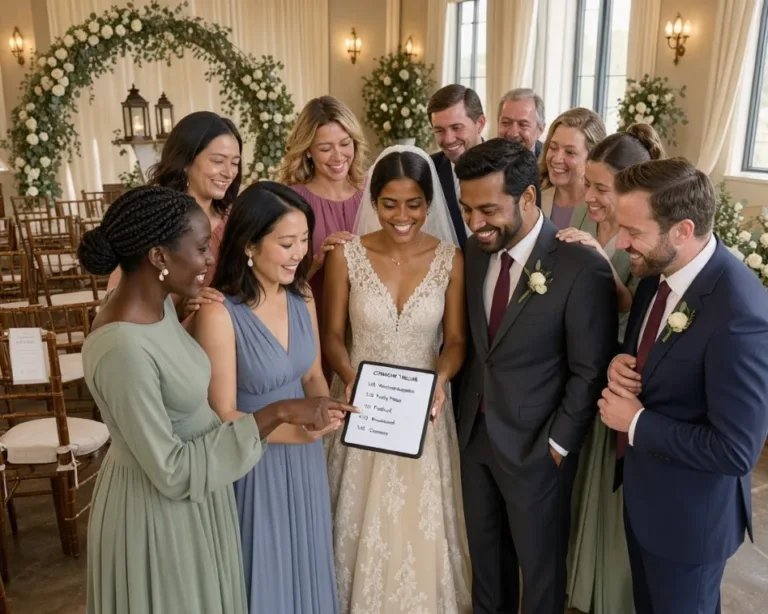
Pick one organized person to direct the group, answer questions, and give the same cues during the ceremony. To coordinate a wedding rehearsal, choose a clear speaker and agree on the plan with the officiant.
The rehearsal lead needs enough confidence to get everyone’s attention, but does not need to be a professional planner. Ask whether they can also cue participants on the wedding day.
Choose the rehearsal lead
A friend or family member can take this role if they are organized and comfortable speaking to a group. Choose someone who can keep the focus on the next movement when people start chatting.
Check that the officiant is comfortable with this plan, including who will give each cue. The officiant may not be able to attend the rehearsal, so the lead should understand the agreed sequence well enough to explain it.
When possible, have the same person cue participants during the ceremony. Familiar instructions can help the wedding party respond without waiting for new directions.
If the lead has another role in the ceremony, confirm who will take over during that part. A second person can help with small tasks, but one voice should direct each movement.
Prepare the ceremony materials
Give the lead the ceremony draft, participant order, and music cues. Include the names of readers and the point in the ceremony when each person speaks.
Send readers the exact text before the rehearsal and ask them to practice their own sections in advance. Keep a backup copy for both the rehearsal and wedding day.
Readers can mark pauses or names that feel hard to say. They do not need to memorize the words, but they should know where to stand and when to begin.
Share the same final draft with the officiant so everyone works from one version. If the ceremony changes, replace old copies rather than asking the group to remember two different plans.
Give the rehearsal lead the final ceremony draft before everyone gathers.
Set the Schedule, Location, and Dinner Buffer
A one-hour rehearsal with an early arrival gives you time to start promptly and still protect the dinner transition. Ask participants to arrive 15-20 minutes early, then plan about one hour for the practice.
Your venue’s open hours and rules shape the date. Rehearsals often happen one or two days before the wedding, but the site may not be free then.
Set the date, location, and start time
If the ceremony venue is not available, a park, backyard, or hotel space can work. Check that the alternate place has room for the group to stand and walk safely.
If you can choose the time, rehearse close to the ceremony’s planned time. The outdoor sunlight check can show whether light will reach the aisle and ceremony area.
Plan 10-15 minutes to unload ceremony items and review them with the venue coordinator. Put that window before or after the rehearsal, based on the venue’s access rules.
A broad wedding planning timeline can help you place this task within wedding week. Keep the rehearsal date tied to the venue’s actual availability.
Build in travel and dinner time
Leave 20-30 minutes between the rehearsal’s end and the rehearsal dinner invitation time, plus travel time. Travel belongs outside that buffer, not inside it.
For a wedding rehearsal schedule template, use this example: arrive at 4:40 p.m., rehearse from 5:00 to 6:00 p.m., then travel from 6:10 to 6:40 p.m. Set the dinner invitation time for 7:00 p.m.
The gap gives people time to leave the venue and reach dinner without rushing. Add more travel time if the two places are far apart or parking takes longer.
Confirm the location, arrival time, and dinner invitation time in one message to attendees.
Decide Who Attends and What Each Person Does
Invite everyone who will walk, be seated, speak, or cue a ceremony moment, rather than treating the run-through as a general gathering. The core group includes the couple, wedding party, and anyone who processes or is seated as part of the ceremony.
The officiant, parents, grandparents, ushers, and readers may each have a specific role. Include only the people whose parts need a place, movement, or cue.
Parents and grandparents may need to practice entering or being seated. Ushers can learn where to guide guests, while readers can check where they will stand.
Children in the ceremony may feel safer practicing beside a parent or another family member. A familiar adult can help them learn when to walk and where to wait.
If one person cannot attend, ask a family member to stand in. A stand-in can help you check spacing and movement without changing the absent person’s role.
The DJ or musician can attend if available, especially when live cues matter. If they cannot come, the rehearsal lead can play the music from a phone.
You do not need every vendor at the rehearsal. A photographer or other vendor can receive the final plan separately if they do not need to practice a ceremony cue.
If your ceremony is at a courthouse, check its guest limits and witness rules before inviting people. These rules can affect who may attend, even when someone has a role.
Tell each attendee what role they are practicing before they arrive.
Courthouse wedding planning can also help you think through the guest and witness details for a small ceremony.
Choose a Ceremony Order That Fits Your Family
Start with the people who need to enter or be seated, then arrange them in the order that fits your ceremony. There is no single required processional order, so you can make changes with your officiant.
Begin with any cultural or religious customs that shape the ceremony. Then consider your parents, grandparents, children, and the way you want to enter as a couple.
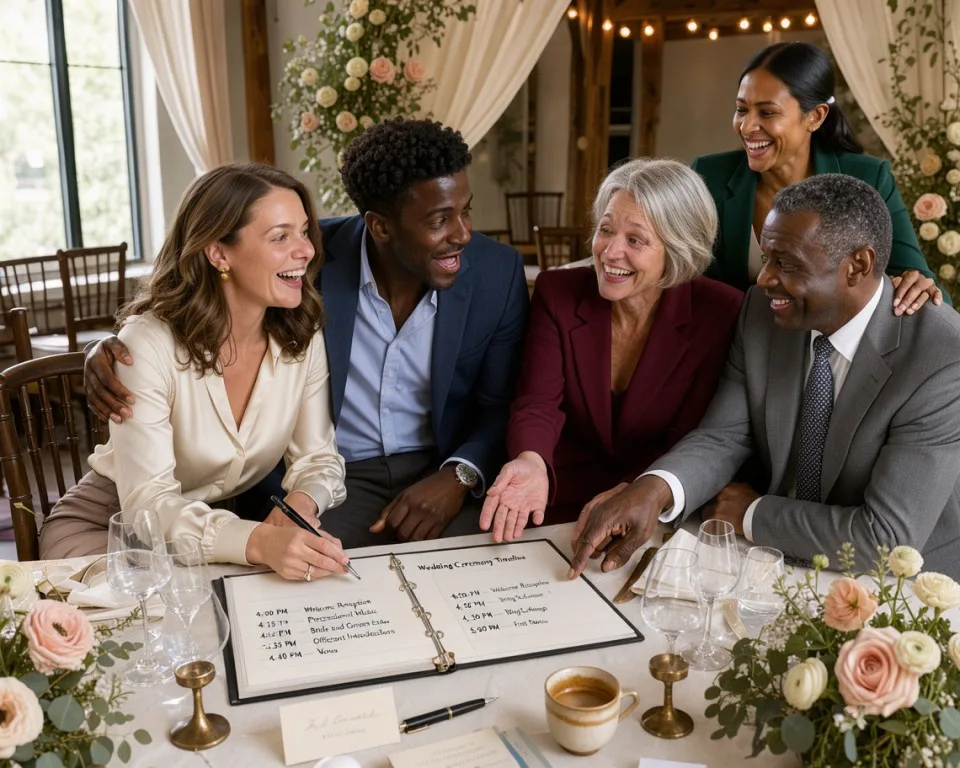
A traditional order may start with grandparents, followed by the groom’s parents and the mother of the bride. The officiant and groom may enter next, followed by the wedding party.
Some couples place the ring bearer and flower girl before the bride, who may enter with her father. This is one option, not a rule for every family.
You can change the order to include stepparents or other close relatives. You can also leave out a traditional role that does not suit your ceremony.
The couple may walk down the aisle together. The officiant can invite guests to stand for both partners, rather than only for the bride.
Unequal numbers of bridesmaids and groomsmen do not have to cause a problem. Two attendants can walk with one person on the other side, or attendants can enter one at a time.
Children may walk with a parent or another trusted adult if that feels right. Make sure each child knows who they will follow and where they will wait.
Ask the officiant to review the order before you treat it as final. Their advice can help you fit family wishes and ceremony customs into one clear sequence.
Share the final order with every person who will walk or cue someone else.
How to Run a Wedding Rehearsal Step by Step
Put everyone in the positions they will occupy during the ceremony before practicing how they get there. Start with the couple, officiant, and wedding party at their places.
Ask the group to pause while you check the setup. A focused walkthrough can keep the sequence clear without turning the rehearsal into a full performance.
Begin at the ceremony positions
Have everyone stand where they will be during the ceremony. Check that the couple and wedding party can see the officiant and each other.
Ask the couple to hold bouquets at a comfortable height. Check that faces remain visible and flowers do not cover anyone’s hands during key moments.
Let each person see where they will stand before asking them to move. A clear starting place makes the next cue easier to follow.
Walk through the ceremony sequence
Have the officiant or lead name the main ceremony headings in order. Include readings, the ring exchange, and any unity ritual that needs coordinated movement.
Practice the actions that may feel new, such as lighting a candle or joining hands. The goal is to learn where objects go and who moves first.
The couple does not need to recite private vows during the rehearsal. They can review the point in the ceremony when those vows happen without sharing their words.
Readers can practice walking to their place and starting their text. The lead can point out the right cue without asking everyone to perform every line.
Pause if a participant cannot tell what happens next. Explain the cue in plain words, then let the person try that movement again.
Use the ceremony draft to check that no part has been missed. Keep the group focused on positions, actions, and the moments when people speak.
Repeat the entrance and exit
Practice the recessional first, then regroup and line up for the processional. The officiant or lead can guide participants through both movements.
Run through the processional and recessional twice if the group needs another try. One pass can teach the route, while the next can confirm the cues.
Give people time to return to their starting places between attempts. A brief pause is better than sending the group into the next movement while confused.
Keep the rehearsal moving, but do not skip a part that needs practice. If a unity ritual requires several people to act together, repeat that action until each person knows their role.
End the run-through only after everyone can identify their starting position and cue.
Practice the Processional, Recessional, and Ceremony Cues
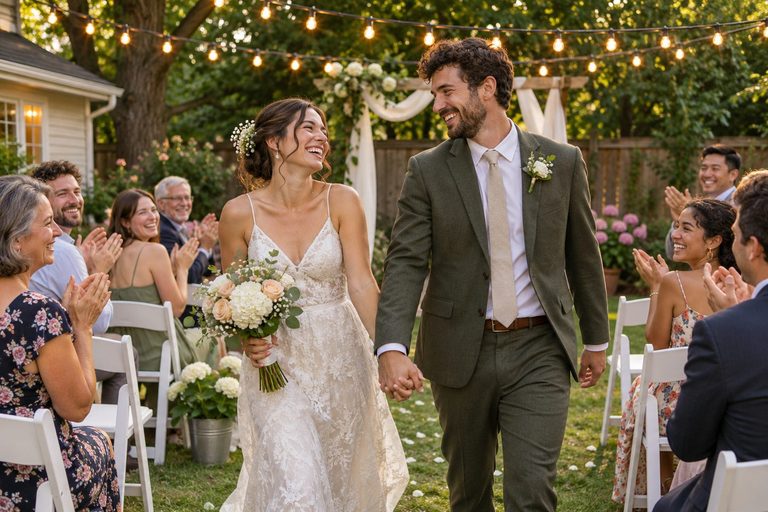
Give the newlyweds room to clear the aisle before the wedding party follows them out. The recessional usually starts with the newlyweds, then flower girls and ring bearers.
The maid of honor and best man can follow, then the rest of the wedding party. Both sets of parents may follow too, if that suits the ceremony.
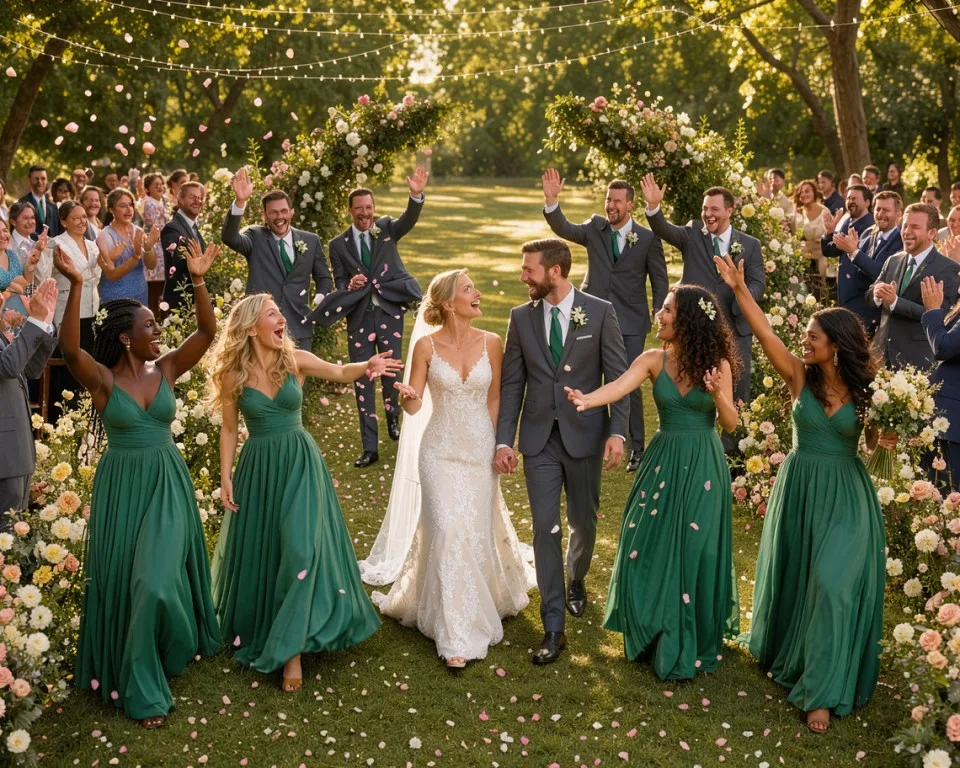
About 20 feet between recessional pairs can leave space for photos. Ask each pair to keep walking until the people ahead have cleared the aisle.
For the processional, 20-30 feet between people or pairs is common. On a short aisle, the next person can wait until the person ahead reaches the front row.
On a longer aisle, the next person can begin near the middle. Adjust the spacing to the room, so the wedding party does not bunch up or leave a long gap.
Walk at a natural pace that follows the music. The traditional processional order can guide your plan, but the couple can adjust it to fit their ceremony.
Check music cues with the musician or DJ when they can attend. If no musician is there, use a phone to test when the music should start and stop.
Practice the escort handoff, bouquet transfer, and ring delivery. Readers and anyone taking part in a unity ceremony should also practice their movements.
For an outdoor ceremony, agree on a backup plan in case the weather changes. Check paths, steps, or uneven ground so people know where to walk.
Advice for an outdoor wedding setup can help you plan for paths, lighting, and a change in weather.
Check that the music cue and the first person’s movement happen together.
Confirm What Happens After the Ceremony
Decide before the ceremony whether you will greet guests in a receiving line or during the reception. A receiving line gives each guest a chance to say hello, but it takes time.
A line for about 150 guests takes 30-45 minutes or more. If you skip it, plan time to thank guests during cocktail hour or the reception.
Choose one person to hold the rings, vows, and marriage license on the wedding day. That person should know when to bring each item to the couple or officiant.
Tell parents and other family members where to gather for portraits. Make the meeting place easy to find, such as the ceremony entrance or a nearby marked room.
Let the wedding party know whether they should stay for photos or leave for the next event. If they are leaving, share the time and place where they should go.
Couples planning a courthouse event can also review courthouse ceremony steps for details about the license and after-ceremony plans.
Name one meeting place for anyone expected to stay for photographs.
Plan the Rehearsal Dinner Guest List and Hosting
Treat the dinner as a chance to bring together the people who helped with the ceremony, with the couple free to choose the guest list and host. A rehearsal dinner is a meal or gathering after the run-through, not another ceremony practice.
The wedding rehearsal dinner can be a relaxed meal, a small gathering, or a brunch when the rehearsal happens earlier. Its size and style can fit the couple and host.
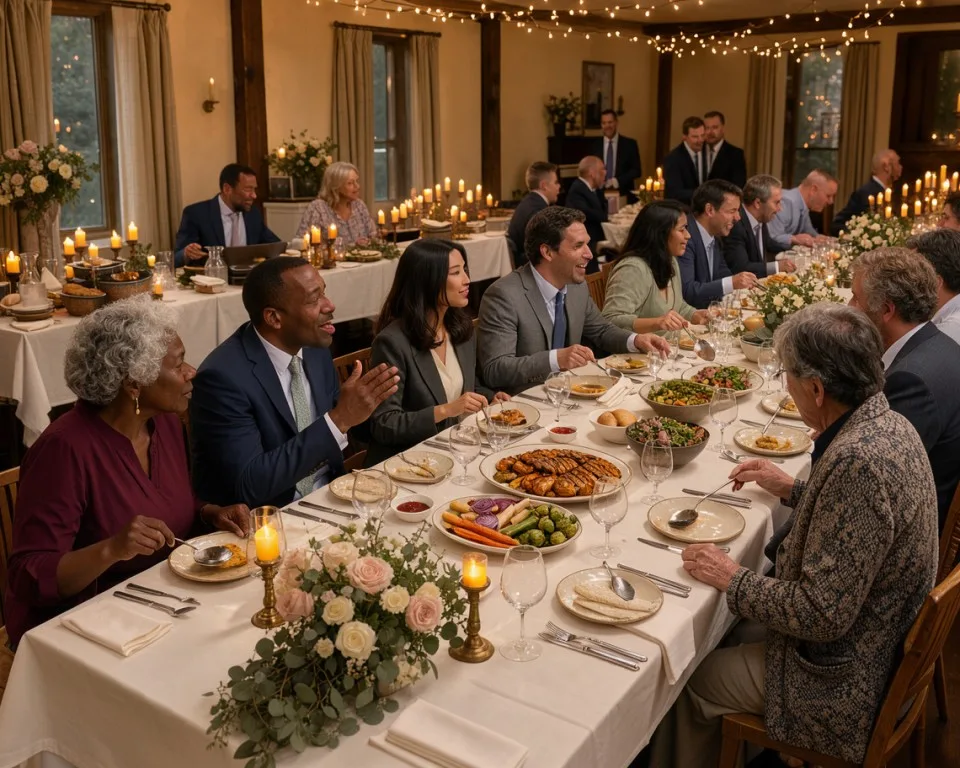
Set the guest list and host
A customary guest list includes the wedding party and their partners, the officiant and their partner, and both partners’ parents. It also includes stepparents, grandparents, and siblings who are not in the wedding party.
Invite the parents of young attendants, such as a flower girl or ring bearer. It is kind to invite a wedding-party member’s date if that person was invited to bring a guest to the wedding.
The groom’s family customarily hosts the dinner, but that custom is not a rule. Either partner’s family, the couple, or both families together may host.
Talk with the couple before anyone takes on hosting duties. A discussion can set expectations for the guest list, meal, and any welcome remarks.
The mother of the bride’s role may include hosting, but that choice belongs to the family. Bridal shower ideas can also spark simple ideas for a casual table or brunch.
Send invitations and choose the format
Send invitations 3-6 weeks before the event. Include the date, start time, address, directions, and a clear way to reply.
Choose a format that feels comfortable for the host and guests. A brunch or luncheon can work well when the rehearsal takes place earlier in the day.
Keep the plan easy for out-of-town family and guests to follow. Clear directions help people reach the right place after the ceremony practice.
Put directions and a clear RSVP method on every invitation.
Set a Rehearsal Dinner Budget That Fits
A per-person estimate is most useful when you pair it with your actual guest count, menu, and drink plan. The 50/30/20 wedding-budget framework assigns 50% to needs, 30% to wants, and 20% to a financial buffer.
Use that split as a planning tool, not a required wedding rule. You can adjust it to fit your full budget and the host’s priorities.
Estimate the total from per-person costs
In 2026, a U.S. rehearsal dinner typically costs $55-$150 per guest for a group of 30-50 people. The total can change with the menu, service style, and drinks.
An average rehearsal dinner cost was $2,800 in a study of 10,474 U.S. couples who married in 2025. That study average and the 2026 per-person range describe different groups and periods.
For 20 guests, do not treat the 30-50-person range as a firm quote. Ask the venue to price your actual menu and service for your guest count.
Plated service typically costs more than buffet service, while a buffet usually costs 20-30% less. An open bar can add $25-$50 or more per person.
Estimate food, drinks, tax, and service charges together. A low menu price may not show the full bill if those costs appear separately.
Choose trade-offs and a budget guardrail
Set a spending limit before choosing upgrades. Then decide which detail matters most, such as a full bar, a plated meal, or a special dessert.
You can keep the meal simple and spend more on a detail guests will notice. Or choose a buffet and use the lower service cost to protect another need.
Ask for a written estimate based on the planned menu and guest count. Compare like with like, including the same drink plan and service details.
Keep a separate buffer in your budget so a menu or service upgrade does not displace an essential expense.
Conclusion
A calm, focused run-through is enough to help your group arrive on the wedding day knowing what to do. Clear cues let each person focus on their own part instead of guessing what comes next.
You do not need to make the rehearsal feel like another ceremony. Let people try the movements, ask questions, and hear the cues they will follow.
Use the final plan as the one version everyone keeps. Send the final schedule and arrival instructions to every ceremony participant.